Stories that grow up with your child
The stories started before she did.
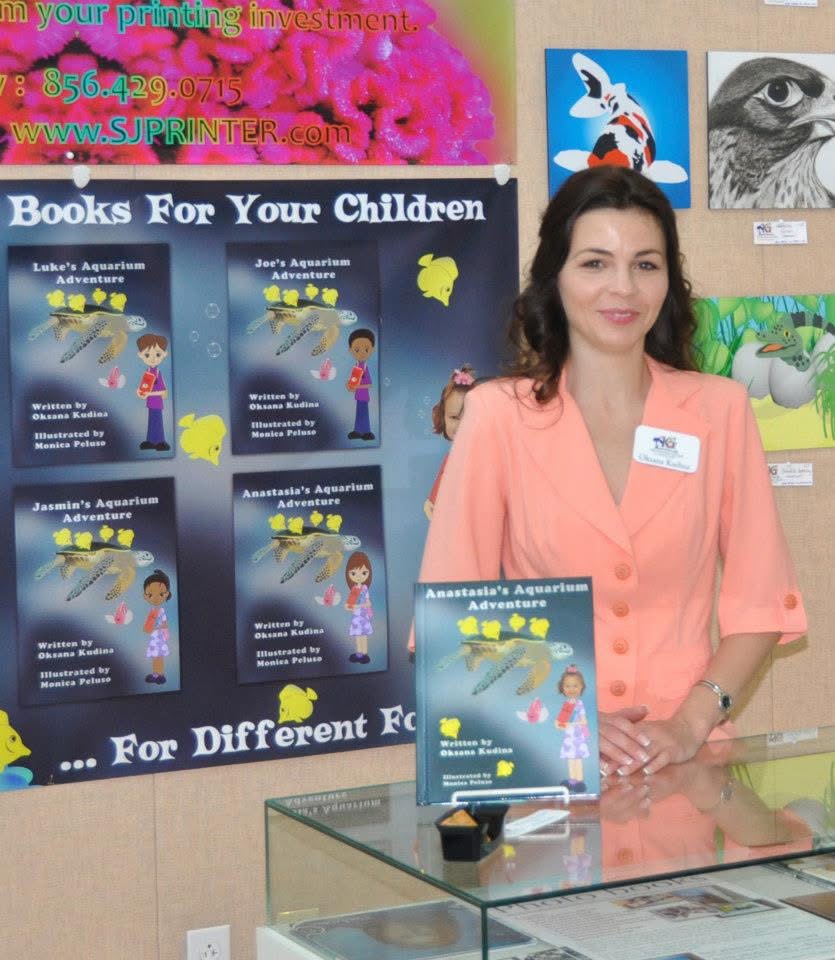
Oksana at a library event — one personalized story, six character options, every child's name on the cover and inside.
Have you seen a child's face the moment they see themselves inside a book? I saw it on my daughter's. That was the beginning.
My grandfather, Professor Vyacheslav Kudin — philosopher, university rector, author of 20 works — spent his evenings inventing stories about Rabbity, Foxy, and Hedgehog. Just for me. I'm Oksana Kudina, his granddaughter. I carried those stories across an ocean when I came from Ukraine. Storytelling isn't something I do. It's what my family is.
When my daughter was five, her class visited the local aquarium. She came home talking about fish for three days straight. So I wrote her a book about it — her name on the cover, her trip, her wonder, her fish. No one else in the world had that story.
I kept writing those books, one at a time, for fifteen years. There's a limit to how many families one person can reach that way. Lulynka removes that limit. The stories are written by AI — but built on what those fifteen years proved: that a personalized story isn't just a name swapped onto a template. It knows your child's world. Their trip. Their fish. The specific thing they came home talking about.
She kept growing.
And the problems that came weren't the kind a bedtime story could fix. Something harder to fix than an injury: the silence. The closed door. The one-word answers. The version of your child who is carrying something enormous, and has decided you're not the person they'll talk to about it. If you're a parent, you know that door.
No lecture opens it. I know, because I tried. But there was something I kept coming back to. My grandfather never walked past a group of teenagers smoking on the street. Not once. He would always stop and talk to them. I was too young to pay attention to what he said — and I am genuinely dying to know. What I remember is the silence. They listened. And when we walked away, they stood there dumbfounded. A professor, a stranger, had said something that reached them, and they didn't know what to do with it.
I've spent years trying to figure out what that was. It led me through antique literature — fairy tales, legends, Greek myths. Stories that never preach. They just sit there, and let you find your way to the answer on your own terms, without anyone standing over you waiting for the right one.
My daughter named the product before I did. She was ten. She flew through the front door after school one afternoon and blurted it out before she'd even put down her bag: "Moooom, why is common sense called common if it's sooo rare???" I could see she was excited and puzzled at the same time — something had happened at school that day. "Hmm," I said. "What should we call it?" She didn't miss a beat. "It's so rare it should be called rare sense." I never forgot that. Years later, when I was trying to name what I was building for teenagers, I kept coming back to that sentence. She gave it to me without knowing what it was for.
That became Rare Sense: a new story every morning for teens, sent directly to their inbox. Your teen knows it's there — they choose when to read it, no one watching over their shoulder. Built to open a door no lecture ever could. It doesn't fix what's happening in a family. No story does.
"Did you read this morning's story?" is so much easier to say than "we need to talk." Sometimes that's the door that opens the rest.
Every parent I've told this story to says the same thing before I'm done: I need this.
Lulynka grows with your child — personalized fairy tales for the years they want their name on the cover, Rare Sense for the years they want space to think on their own. It's also the most personal gift a grandparent can give. The face changes. The need for a story never does.
— Oksana Kudina, Founder of Lulynka
Published children's book author — see my books on Amazon